---
title: Euler's Identity
date: '2019-10-30'
words: 574
collection: mathematics
---
$$
e^{\pi i} + 1 = 0
$$
This equation is supremely beautiful and bewildering. It uses 5 **very**
fundamental objects: $$0$$, $$1$$, $$\pi = 3.141\ldots$$, $$e = 2.718\ldots$$,
and $$i = \sqrt{-1}$$, along with 4 operations: $$a + b$$ (addition), $$a b$$
(multiplication), $$a^b$$ (exponentiation), and finally $$a = b$$ (equality,
identity).
$$
e^{\frac{\pi i}{2}} = i \\
e^{\pi i} = (e^{\frac{\pi i}{2}})^2 = i^2 = -1 \\
e^{\frac{3\pi i}{2}} = (e^{\frac{\pi i}{2}})^3 = i^3 = -i \\
e^{2\pi i} = (e^{\frac{\pi i}{2}})^4 = i^4 = 1
$$
Then it repeats...
$$
e^{\frac{5\pi i}{2}} = (e^{\frac{\pi i}{2}})^5 = i^5 = i \\
\vdots
$$
If you can't see the "whole" picture yet (can anyone?), this might help. Our
cyclic circular sidekicks, $$\sin$$ and $$\cos$$ are here to enlighten us.
Euler's identity is a special case of _Euler's formula_, which states:
$$
e^{i \theta} = \cos(\theta) + i \sin(\theta)
$$
Substitute $$\pi$$ (or in general, $$n\pi$$) for $$\theta$$ and we get back our
identity.
$$
\begin{align}
\cos(\pi) + i \sin(\pi) = -1 + 0 =\ & e^{\pi i} = i^2 \\
& e^{\pi i} + 1 = 0
\end{align}
$$
Tangent on Fourier Series
TODO: This information is only a sketch, and as such is somewhat sketchy.
```
Plot[
sin(theta)/pi,
(3/2) sin(theta)/pi,
2 sin(theta)/pi,
(5/2) sin(theta)/pi
]
```
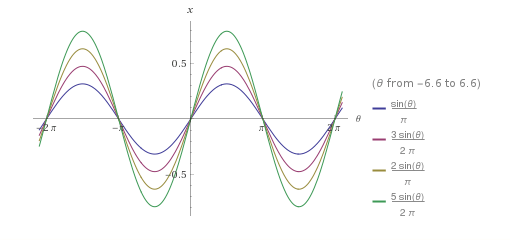
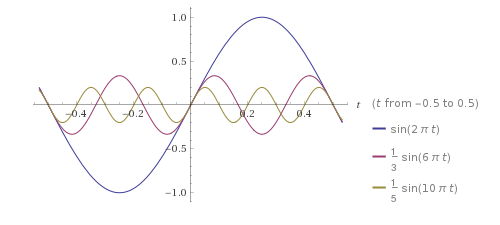
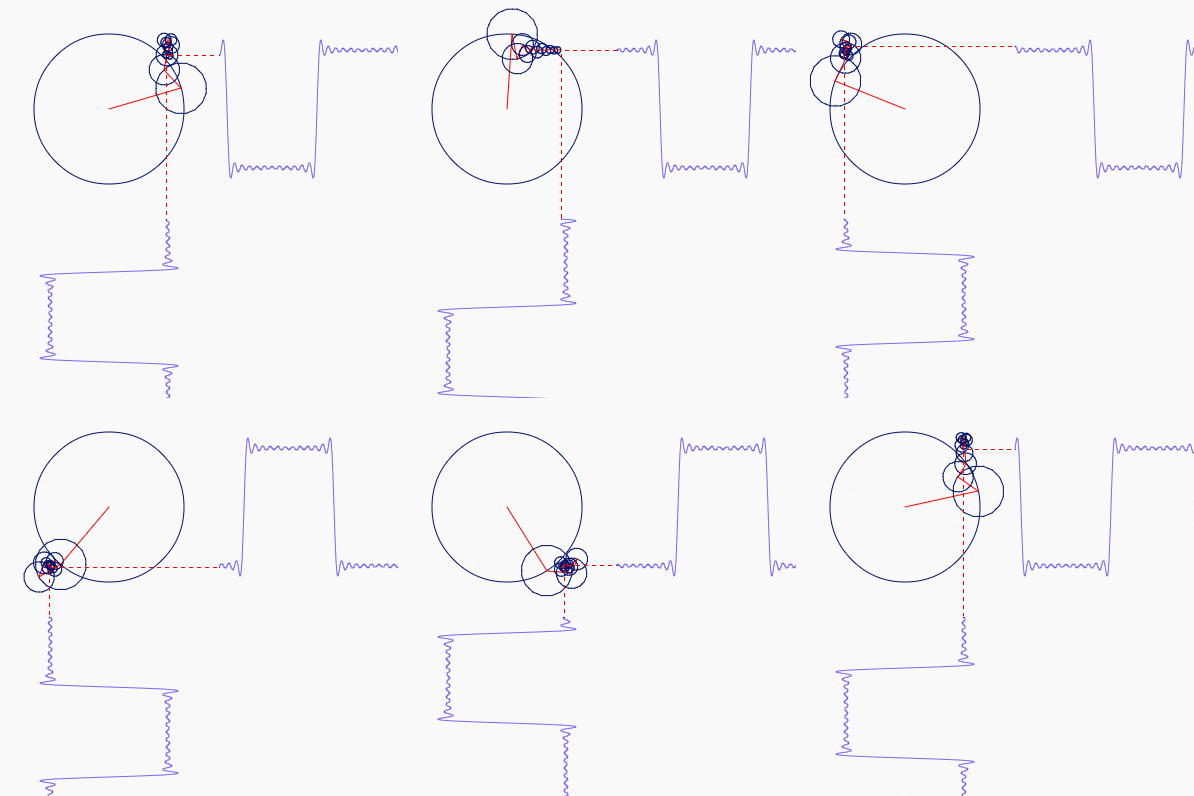
Unlike the "Euler series" we above, which is purely constructive, a square
wave can be constructed with the Fourier series:
$$
\sin(2 \pi \theta),
\frac{1}{3} \sin(6 \pi \theta),
\frac{1}{5} \sin(10 \pi \theta),
...
$$
```
Plot[
sin(2 pi theta),
(1/3) sin(6 pi theta),
(1/5) sin(10 pi theta)
]
```
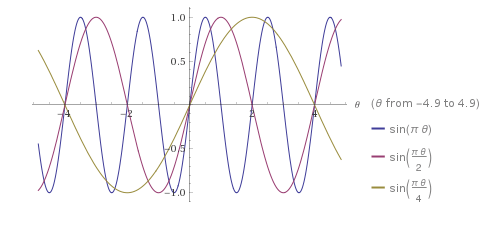
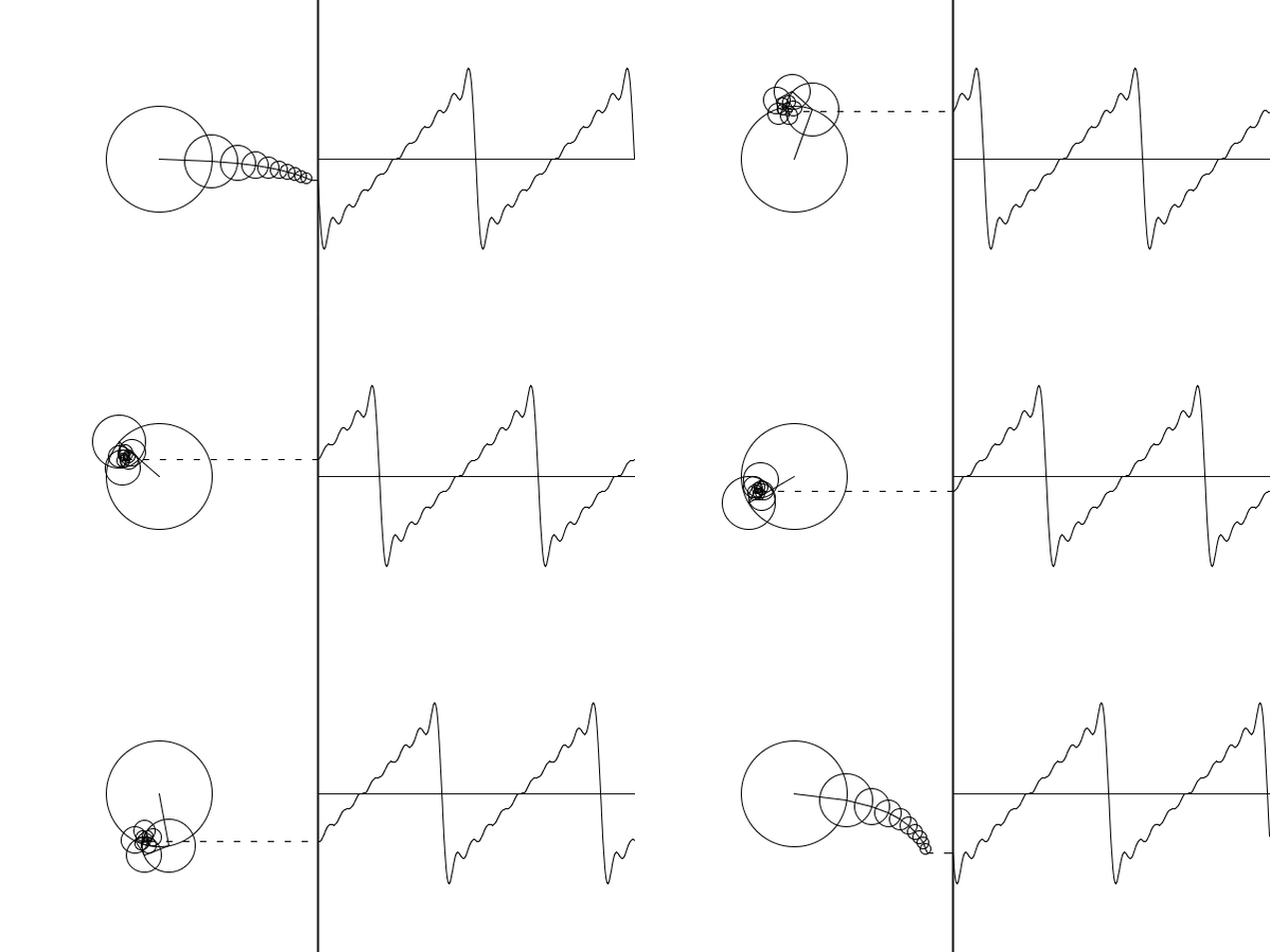
And a saw wave can be constructed by another:
$$
\sin(\pi \theta),
\sin(\frac{\pi \theta}{2}),
\sin(\frac{\pi \theta}{4}),
\ldots
$$
```
Plot[
sin(pi theta),
sin((pi theta) / 2),
sin((pi theta) / 4)
]
```
> Euler's identity can be geometrically interpreted as saying that rotating any
> point $$\pi$$ radians around an origin of a complex plane has the same effect
> as reflecting the point across the origin.
>
> -- [Wikipedia](https://en.wikipedia.org/wiki/Euler's_identity#Geometric_interpretation)
Fundamentally, Euler's Identity is a root of unity, meaning that it is a
solution for $$z$$ in the equation $$z^n = 1$$.
$$
z = e^{2\pi i} = i^4
$$
This is the definition for a more general identity which states that the
$$n$$th roots of unity, for $$n \gt 1$$, add up to $$0$$.
$$
\sum_{k=0}^{n-1} e^{2\pi i\frac{k}{n}} = 0
$$
Euler's identity is the $$n = 2$$ case of this equation.
$$
e^0 + e^{\pi i} = e^{\pi i} + 1 = 0
$$
A fun fact from a friend.
My friend Ryan showed me an interesting approximation of $$e$$ which uses
numbers $$1, 2, 3, 4, 5, 6, 7, 8, 9$$ each once:
$$
e \approx \left(1 + 9^{-4^{6 \times 7}}\right)^{3^{2^{85}}}
$$
This may be less surprising if we recall that $$e$$ can be defined as:
$$
e = \lim_{n \to \infty} \left(1 + \frac{1}{n}\right)^n
$$
So we have $$n \gets 3^{2^{85}} \approx \left(9^{-4^{6 \times 7}}\right)^{-1}$$,
which substituting in the above, gives an approximation of $$e$$.
Wanna compute e in
Brainfuck?
$$
\hphantom{nothing} \\
e = 2.718281828459\ldots
$$
git clone https://github.com/nixpulvis/brainfuck
cd brainfuck
cargo run fixtures/e.bf
>>>>++>+>++>+>>++<+[
  [>[>>[>>>>]<<<<[[>>>>+<<<<-]<<<<]>>>>>>]+<]>-
  >>--[+[+++<<<<--]++>>>>--]+[>>>>]<<<<[<<+<+<]<<[
    >>>>>>[[<<<<+>>>>-]>>>>]<<<<<<<<[<<<<]
    >>-[<<+>>-]+<<[->>>>[-[+>>>>-]-<<-[>>>>-]++>>+[-<<<<+]+>>>>]<<<<[<<<<]]
    >[-[<+>-]]+<[->>>>[-[+>>>>-]-<<<-[>>>>-]++>>>+[-<<<<+]+>>>>]<<<<[<<<<]]<<
  ]>>>+[>>>>]-[+<<<<--]++[<<<<]>>>+[
    >-[
      >>[--[++>>+>>--]-<[-[-[+++<<<<-]+>>>>-]]++>+[-<<<<+]++>>+>>]
      <<[>[<-<<<]+<]>->>>
    ]+>[>>>>]-[+<<<<--]++<[
      [>>>>]<<<<[
        -[->--[<->+]++<[[>-<+]++[<<<<]+>>+>>-]++<<<<-]
        >-[+[<+[<<<<]>]<+>]+<[->->>>[-]]+<<<<
      ]
    ]>[<<<<]>[
      -[
        -[
          +++++[>++++++++<-]>-.>>>-[<<<----.<]<[<<]>>[-]>->>+[
            [>>>>]+[-[->>>>+>>>>>>>>-[-[+++<<<<[-]]+>>>>-]++[<<<<]]+<<<<]>>>
          ]+<+<<
        ]>[
          -[
            ->[--[++>>>>--]->[-[-[+++<<<<-]+>>>>-]]++<+[-<<<<+]++>>>>]
            <<<<[>[<<<<]+<]>->>
          ]<
        ]>>>>[--[++>>>>--]-<--[+++>>>>--]+>+[-<<<<+]++>>>>]<<<<<[<<<<]<
      ]>[>+<<++<]<
    ]>[+>[--[++>>>>--]->--[+++>>>>--]+<+[-<<<<+]++>>>>]<<<[<<<<]]>>
  ]>
]

This program computes the transcendental number e, in decimal. Because this is
infinitely long, this program doesn't terminate on its own; you will have to
kill it. The fact that it doesn't output any linefeeds may also give certain
implementations trouble, including some of mine.

(c) 2016 Daniel B. Cristofani
http://brainfuck.org/